Sustainability at IJM
Sustainability is integrated into IJM’s operations and long-term business strategy. The Group is committed to aligning its business decisions with Economic, Environment, and Social principles, supporting long-term resilience and creating shared value for stakeholders. These priorities underpin IJM’s approach to planning, delivery, and business management across the Group.
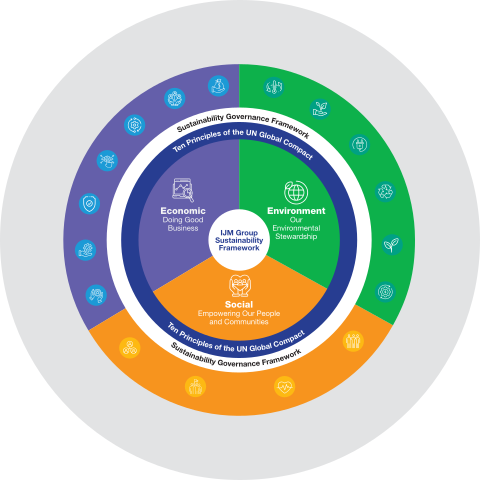
Guided by the IJM Group Sustainability Framework, our efforts are organised around these three principles with each anchored in material matters most relevant to our business and stakeholders. Our sustainability priorities align with key UN SDGs and are incorporated into project planning, procurement, and risk management processes. In parallel, IJM is progressively expanding the scope of our sustainability reporting.
Sustainability Framework
IJM’s sustainability journey is guided by the Group Sustainability Framework, which provides the structure and governance for integrating economic, environmental and social principles across the Group’s operations. The framework sets strategic direction and performance management mechanisms to support the systematic embedding of sustainability into business processes and decision-making. It aligns with internationally recognised standards and benchmarks, including the UN SDGs, the IFRS S1 and S2 and Malaysia’s national climate agenda, supporting consistent implementation and reporting across the Group.
At IJM, we are committed to creating long-term economic value by conducting our business with integrity, transparency and a strong foundation of ethics. We understand that economic growth must be inclusive and responsible and we ensure that all our commercial activities are underpinned by good governance, innovation and sustainability.
We acknowledge that the role of environmental health, reflected in the state of Earth’s natural systems and their capacity to sustain life, is deeply interconnected with our efforts to address climate change. Scientific evidence shows that six out of nine planetary boundaries have already been transgressed, indicating increasing pressure on the Earth’s systems and a potential shift away from a safe operating space for humanity. With this in mind, we have mitigation and adaption strategies for our sustainability framework.
We recognise that the long-term success of our business is linked to our ability to build and maintain a good relationship with our employees, communities and other stakeholders. We are committed to fostering an environment that supports the social wellbeing of all our people and the broader community. To ensure that our efforts align with our strategic objectives, we have implemented a comprehensive approach that includes clear policies and procedures, frameworks, initiatives and regular assessments to create an inclusive workplace that is positive and responsible.
Sustainability Roadmap
Endorsed by the Board of Directors, the Sustainability Roadmap FY2023–FY2025 was built on three key pillars: Economic, Environment and Social.
Serving as a strategic blueprint for our business divisions, the Roadmap outlines how sustainability goals and strategies are embedded across the organisation, supported by defined internal performance measures.
Deepen Stakeholder Engagement
Engage stakeholders as a key strategy to keep pace with evolving expectations
Engage Supply Chain
Engage the supply chain to achieve meaningful and lasting impact
Digitalise Data Collection and Reporting
Leverage digital technology for effective data collection, performance measurement and reporting
Communicate Sustainability Progress
Communicate sustainability progress to stakeholders
Establish Climate Strategy
Establish a climate strategy that includes a carbon footprint assessment, a carbon reduction strategy and an assessment of climate-related risks and opportunities
Pursue Green Credentials
Integrate green elements into our products and services
Enhance Human Rights Practices
Improve labour practices to align with local and global standards
Elevate Culture and Capabilities
Conduct a series of learning, sharing and awareness programmes along with regular engagements
Implement Community Investment Framework and Strategy
Implement community investment themes, focus areas and metrics used for impact measurement
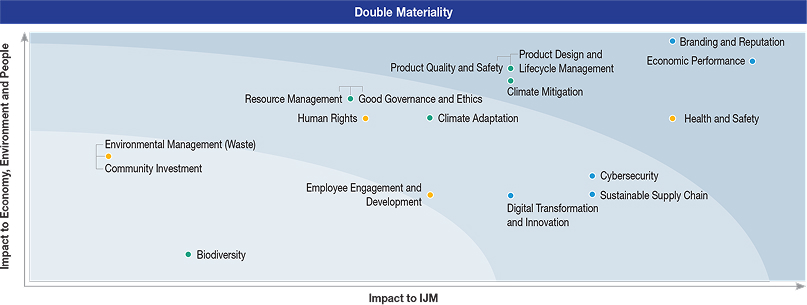
Double Materiality Matrix
Based on the result of our refreshed double materiality assessment, the 17 material matters have been mapped onto a double materiality matrix, reflecting both impact to IJM (Financial materiality) and impact to the economy, environment and people (Impact materiality). Endorsed by the Board, this matrix provides a strategic foundation to guide integrated decision-making, resource allocation and long-term value creation.
Our Global Alignment
Our sustainability performance is reported on an annual basis, prepared in accordance with the local regulatory guidelines. We have taken into consideration the international sustainability reporting frameworks, standards and guidelines: